If you’re planning a kitchen renovation and thinking ahead to resale, you’re making a smart move — especially here along the Gold Coast in Westport and Fairfield, where thoughtful updates can set your home apart from others on the market.
And if you’re considering sustainable upgrades along the way? Even better. Today’s buyers are not only drawn to beautifully designed kitchens — they’re also looking for homes that are more efficient, environmentally friendly, and aligned with modern values.
💡 The Data: Buyers Are Asking for Energy Efficiency
According to the National Association of Realtors 2023 Sustainability Report,
63% of Realtors said promoting energy efficiency in listings is valuable.
Nearly half of all buyers are interested in sustainability and green features.
And from Zillow’s Consumer Housing Trends Report:
60% of homebuyers said they would pay more for a home with energy-efficient features — especially kitchens with updated appliances and smart design.
Younger buyers in particular are driving this trend, and they’re not just dreaming about eco-conscious living — they’re shopping for it.
🍽️ Smart, Sustainable Upgrades to Consider
As you plan your kitchen renovation, here are a few upgrades that add style, improve efficiency, and speak directly to what buyers want:
ENERGY STAR® Appliances – Efficient refrigerators, dishwashers, and microwaves that lower utility bills and appeal to buyers focused on long-term value.
LED Lighting – Energy-saving fixtures that modernize your space and reduce consumption.
Low-Flow Faucets – Subtle, stylish upgrades that conserve water and increase appeal.
Sustainable Surfaces – Recycled glass countertops, bamboo flooring, or FSC-certified cabinetry offer durability with eco-conscious flair.
Better Insulation & Ventilation – Ideal for coastal homes where climate control is key to comfort and energy use.
🏡 How I Maximize the Value of Green Features in Your Sale
When it comes time to sell, I make sure these eco-friendly choices don’t go unnoticed. Here’s how I bring their value front and center:
✅ Feature Highlighting – I call out sustainable elements in the MLS listing, brochures, social posts, and property descriptions with attention-grabbing language and targeted keywords.
✅ Energy-Efficiency Messaging – I tie the green features to long-term savings and buyer peace of mind, which resonates with both cost-conscious and environmentally aware shoppers.
✅ Appeal to the Modern Buyer – I tailor marketing to appeal to today’s buyer — especially Millennials and Gen Z — who are actively seeking homes that reflect their values.
✅ Lifestyle Framing – It’s not just about efficiency — it’s about lifestyle. I show how your kitchen supports wellness, smarter living, and even resale value down the line.
✨ In a Beachside Home, Efficiency Matters Even More
Homes by the water, like those along the Fairfield County shoreline, can come with higher exposure to weather and energy use. A well-designed, sustainable kitchen adds functional and emotional value — something I highlight strategically in every showing and piece of marketing.
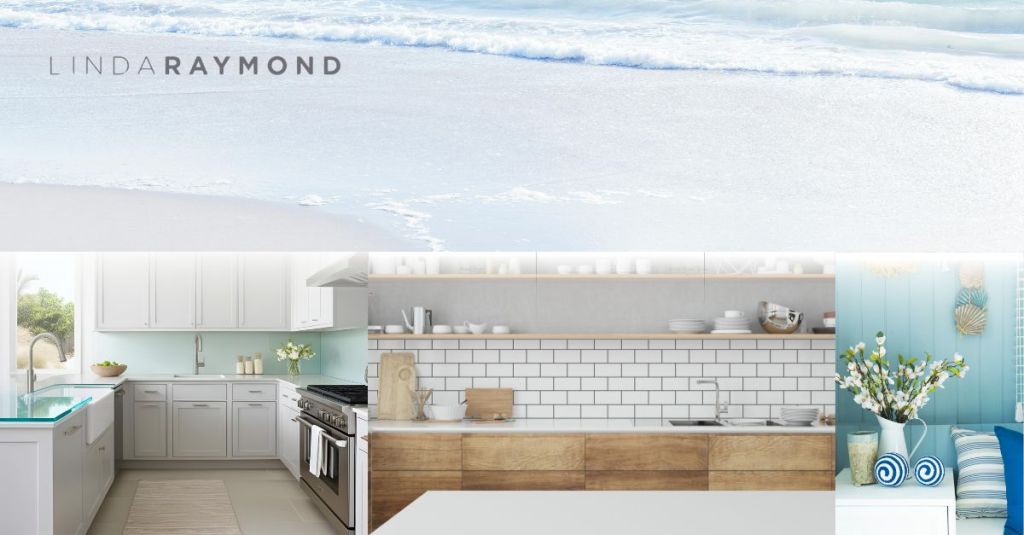
📸 Picture this Concept: Eco-Chic Coastal Kitchen
Style: Modern coastal with clean lines and a light, airy feel
Cabinetry: Sleek white or soft matte gray shaker cabinets
Countertops: Recycled glass or light quartz surfaces
Appliances: Stainless steel, ENERGY STAR® rated (subtle labeling optional)
Lighting: Minimalist LED pendant lights (think matte black or brushed nickel)
Flooring: Bamboo, cork, or warm-toned sustainable wood
Natural elements:
A small potted herb garden on the windowsill or counter
Bowl of lemons or a vase with greenery
Large window letting in natural light
Beachy accents:
Subtle sea glass tones (light blue or soft green) in backsplash or decor
Coastal artwork or a driftwood tray
Let’s Position Your Kitchen for the Highest Return
If you’re making eco-friendly upgrades with an eye toward a future sale, I can help you maximize their impact when the time comes to list. When marketed the right way, a green kitchen does more than save energy — it attracts the right buyer, builds value, and helps you stand out in a competitive market.
Call to Action: 📩 Have questions about which features buyers value most — and how to spotlight them when you sell? Let’s connect. I’d love to help you position your home for top dollar.
You probably don’t have to worry about replacing your driveway anytime soon.
But if you did….would you ever think of replacing it with something other than asphalt?
It doesn’t occur to most of us to seek out “green” alternatives. Yet, there are a growing array of options for ways to preserve our environment and reduce carbon emissions that cause dangerous global warming and increasingly extreme and destructive weather events.
“Asphalt and concrete are old school bad boys”, -Stephen Treffinger in an article from MYND, a real estate investing firm.
Everyone has asphalt driveways. What’s wrong with asphalt?
Asphalt and concrete are not sustainable. The main component of asphalt is petroleum, which is a limited resource found beneath the earth’s surface. The process of extracting it consumes large amounts of energy and also disrupts the surrounding environment. In fact the extraction process is thought to be the cause of earthquakes in Oklahoma according to Aexel Corporation. The asphalt and its production release dangerous and toxic carbon emissions and VOCs (Volatile Organic Compounds) into the atmosphere. Blacktop then absorbs and re-emits the sun’s heat back into the air causing higher temperatures, whereas natural landscape materials do not. And last, but not least, the pavement (along with all impermeable surfaces) threatens our water supply by preventing natural filtration of water through the ground. Instead it causes water contaminated by the asphalt and other debris to run-off the hard surface and mix with the sewage drainage system before ending up back into our rivers.
The overriding philosophy of GI is to emulate the way natural systems manage water. For instance, runoff can be thought of as a “waste” of water in a natural landscape. A natural landscape tends to conserve water; it is a natural cooling system, a natural material/food delivery system, a cleansing system, and a cell structural maintenance system among other things. The water cycle is nature’s way of collecting, storing, and timing the redistribution of water across landscapes.
Runoff is water that is not captured by upland landscapes for their needs.
GI describes the processes of using various techniques that seek to mimic the soil’s natural ability to infiltrate runoff. This is important as climate change projections for New England generally predict warmer temperatures with increasingly strong storms and high precipitation events. This can cause the seemingly paradoxical effects of increased drought from the high temperatures while also increasing the risk of flooding from the strong storm events. GI can help negate both consequences by taking water that would otherwise runoff, swelling brooks and rivers, and instead allowing that water to infiltrate into the ground or be captured and used directly.
Is green the new black? 🌱
Asphalt recycling and more porous alternatives can be used until better solutions become readily available. But here are some methods for greening our driveways for a more eco-conscious future, shared from MYND.
Gravel – Pros: It is inexpensive at $1 to $2 per square foot, can be locally sourced, and is very porous, making it a highly eco-friendly, green option. Cons: It could pose a challenge to plowing in the winter.
Seashells 🐚 – Pros: The shells can be collected without harming the shoreline and processed into a porous and durable mix. It is low-cost at under $1 per square foot. Shells over time will breakdown and provide nutrients to the soil and area plants. Shells are safe for the environment and add a beach flair to your home. Cons: This alternative is not available in all areas, and the driveway is not comfortable to walk on barefoot.
Permeable paver system 💧- Pros: This approach has more conventional look with solid pavers that allow water to drain down between them. It uses clear crushed stone between the pavers and a layer underneath that’s about a foot deep. This allows water to filter into the ground naturally instead of running over the surface into the city drainage system. Cons: These are pricier at $15 to $30 per square foot.
Grass 🦠 – Pros: A structured grid buried below the ground’s surface provides a supportive structure for grass giving it the strength to function as a driveway. This allows water to filter through the ground just like the rest of your lawn. GD Grass System is a provider. Cons: There would not be a visual distinction between the grass yard and driveway unless you create a border with additional landscaping.
“Solar Freakin Roadways!!!” 👽- Yes, you read this right! There is a company in Idaho called Solar Roadways that makes solar road panels [<= CLICK THAT LINK. THE 7-MINUTE VIDEO IS ENTERTAINING, ENLIGHTENING AND A MUST-SEE!]. Pros: This is an amazing technology that uses sustainable materials to make, not just solar, but SMART road panels. They are modular panels that fit together to prevent cracking. They generate energy, produce an ROI, charge electric vehicles, enable underground wiring, provide traction, heat up to prevent ice and snow accumulation, light up for a festive display, can send emergency alerts, and can be programmed on demand to create range of light patterns or sports quarts, and yes, they provide a place to park! Cons: As an emerging technology, they are not cheap at the moment, but the price will come down.
Hemp 🪴- Pros: Light-weight bricks can be created from the strong inner fibers of hemp that can last for years. The lighter weight makes transporting them less expensive and less impactful on the environment. The added bonus is that they absorb carbon from the atmosphere just like trees. Cons: Hemp might not be legal in all areas.
Fungi 🍄🟫 – Pros: This is another evolving technology where mushrooms can actually be used to make strong bricks! Fungal threads, or mycelium, are introduced to a substrate which they consume, digest, and convert into a strong solid mass. The mycelium basically act like “glue that binds together different natural particles” says Critical Concrete. The benefits to mycelium are that it can create material that’s stronger than concrete, can absorb more heat than fiberglass, is fire-proof, non-toxic, very light weight when dry, and can last up to 20 years if maintained in favorable conditions. Cons: the mycelium is water and mold resistant initially but gradually loses this capacity over time. The key is finding ways to keep it in stable conditions to prevent it from decomposing.
I hope this article sparked some awareness and intrigue 🤩 about green alternatives that support sustainability. The more we learn about the ways to protect our environment, the more focused on its importance we may become, and the more we can take action for a greener 💚 and more sustainable 🔮 future.
By Linda Raymond, CT Realtor® | William Raveis Southport | NAR Green Designee
Did you know that most U.S. homes are not built for energy efficiency? In fact, over half of all homes were built before 1980, according to National Home Builders Association, citing the ACS 2021 Survey. New construction has been declining, and the median home age has climbed to 40 years. That means we’re moving away from energy efficiency at a time when conservation matters most.
But here’s the good news: you don’t need a brand-new home to live sustainably! 🌿 With the right upgrades, retrofitting an existing home can cut energy use by up to 70%, per NAR. That’s a huge opportunity to save money, increase comfort, and boost home value.
🌟 What Makes a Home “High-Performance”?
A high-performance home isn’t just energy-efficient—it’s healthier, more comfortable, and cost-effective to maintain. Key features include: ✅ Better Insulation & Windows – Keeps temperatures stable year-round ✅ Efficient Heating & Cooling – Reduces energy waste and lowers bills ✅ Smart Water Use – Saves money and conserves resources ✅ Improved Indoor Air Quality – Filters out pollutants for a healthier home
🔥 Why This Matters Now
Energy costs are rising, and climate concerns are growing. The homes we already live in hold the key to a more sustainable future. Small improvements—like upgrading appliances, sealing air leaks, or adding solar—can make a big impact. And if you’re thinking of selling? Buyers are increasingly prioritizing energy-efficient features when choosing a home.
NAR: “The survey revealed that an overwhelming 63% of respondents recognized the value of promoting energy efficiency in property listings. As the awareness of environmental issues grows, buyers increasingly prioritize energy-efficient features that reduce their carbon footprint and lead to cost savings in the long run.”
Want to explore eco-friendly upgrades or find a home that’s already optimized for efficiency? Let’s connect!
📩 Stay in the Know! Sign up for my e-newsletter for more expert insights on homes, market trends, and smart real estate moves.
Committing to highly ambitious New Year’s resolutions may be as American as apple pie, but then so too is the tendency to call it quits before they’ve been realized, with nearly one in four of us jumping ship within the first week alone. So we’ve put together a list of resolutions that come with such a high return on your investment (ROI), even if you only hit one, you’ll be in pretty good shape.
Better yet, nearly all of these New Year’s resolutions come with rebates or tax credits via the Inflation Reduction Act (IRA) of 2022, so you really won’t have an excuse to not get started.
Here’s to a happy, healthy 2025!
1. Lower Cost, Good ROI: Smart Thermostats
If you’re anything like the average U.S. household, nearly half of your annual home energy expenditures go toward heating and cooling, which nets out to more than $900 each year. What if you could pay less in the year ahead?
One simple solution may help you do so: installing a smart thermostat.
But what do these smart thermostats even do, exactly? Like most of today’s latest-and-greatest smart home tech, smart thermostats bridge the physical and digital, enabling you to do more than just, say, adjust the temperature in your house. Instead, these thermostats use your input and preferences as a starting point, then automate and optimize your home’s energy settings from there, with the goal of striking an ideal balance between sustainability, on the one hand, and comfort, on the other.
Just be sure to pick up a model that has earned the ENERGY STAR® label: These smart thermostats are powered by algorithms based on 12 months or more of real-world energy-usage data in similar homes, for starters. Rigorously and independently certified and tested, these models must be able to demonstrate efficacy regardless of climate, too. Finally, studies show that these smart thermostats — and these smart thermostats alone — reduce household energy bills by around 8% on average. Adopted at scale, what’s more, smart thermostats might curb U.S. carbon emissions by as much as 18 billion pounds annually.
So getting a new, smart thermostat for your home in the new year is a smart move for many reasons. It’s also easy to do, and local utilities may even offer rebates when you buy (check Green Door for those). Note that in some cases, depending on how your heating and cooling systems are wired, you may need to have a qualified electrician on hand.
2. Medium Cost, Great ROI: Attic Insulation and Air Sealing
Best-in-class insulation for attics is a key ingredient of most high-performing homes, for reasons that are fairly straightforward to explain.
As you probably remember from high school science class, heat moves from warmer to cooler areas, which can result in warm air escaping through un- or under-insulated areas in your home. During the warmer months, the opposite is true, with equally undesirable results: Hot air streams in through gaps in your insulation, thereby pushing cold air out of your home, decreasing the efficacy of air conditioners and increasing home energy costs in turn.
Both scenarios can result in needlessly high energy bills, which is why, according to the EPA, you stand to save 15% on heating and cooling costs — or around 11% on overall energy costs — by adding insulation and air sealing your home. This is also one of the reasons why, within our scoring system at Pearl, attic insulation earns a relatively high number of points toward a Silver, Gold, or Platinum Pearl Certification — it’s an investment you ideally make once that has a huge impact for years to come. Plus, you can save on installation costs with rebates and tax credits under the IRA and other programs.
3. Higher Cost, Excellent ROI: Energy-Efficient Windows
After making initial headway with the addition of smart thermostats and attic insulation, the next logical step is window replacements. After all, these investments further insulate your building shell and provide a level of protection from extreme weather events. They can also pay for themselves rather quickly.
While you’re at it, just be sure to dial in to the specific needs of your home. And be sure to look for rebates and tax credits in Green Door — there’s opportunity to save significantly, particularly if you’re ordering at volume.
Finally, use the Green Door app to identify a local solar Pearl Network Contractor to help you calculate potential cost savings and arrive at the right budget. Only Pearl Network Contractors can use the Pearl Solar Equity Calculator® to calculate a 20-year discounted cash flow using certified contractor data, National Renewable Energy Laboratory (NREL) software, and Freddie Mac’s 30-year mortgage rate. With the report you’ll better understand the cost, savings, and value of your solar investment.
5. Higher Cost, Excellent ROI Resolution: Electric Vehicles
The future of U.S. transportation is, in many respects, already here in the form of electric vehicles (EVs), with huge implications for not only the future of greenhouse gas emissions but the health and well-being of your pocketbook in the present day.
For starters, consider the near-term gains: Going anywhere in an EV costs as little as $0.84 per gallon-equivalent, which is fully 66% less than the $2.50-per-gallon average you would expect to pay in a carbon-emitting alternative. So everyjourney should confer some measure of cost savings in your new vehicle — and by putting the “EV” in “every,” you’ll be helping to offset the cost of that investment right off the bat.
Of course, not everyone will be realistically in the market for a vehicle upgrade in 2025, which is why we saved this sustainability investment for last. Still, you shouldn’t overlook the potential upside of doing so down the road. It’s the one performance upgrade that has the power to literally take you to new places each and every day — and to transform your experience of transport in the year ahead, too.
Improving your home’s energy efficiency, shrinking your overall carbon footprint, and realizing significant cost savings over the near and long term are attainable resolutions for every homeowner in 2025 — especially as states roll out their IRA rebates programs. Just be sure to take it one step at a time and to prioritize projects based on your financial goals. That’ll better position you for success, shorten your timeline to impact, and ensure you see the expected ROI.
If you’re alarmed by the sharp rise in carbon emissions and corresponding global temperatures shown in these Climate.gov charts, you’re not alone. Experts, including the United Nations, warn that our current energy policies are leading us toward a global temperature increase more than double the 1.5°C limit set by the 2015 Paris Agreement.
💡 Start at Home Reducing your home’s carbon footprint is a powerful way to make a difference. Small changes can lead to big impacts.
So, what can we do? Achieving net zero emissions—where greenhouse gas emissions are balanced by their reduction and removal—is essential to combat climate change. This means drastically reducing our emissions and embracing sustainable practices.
Check out five high-value upgrades you can make in 2025! Stay tuned. I’ll be sharing more actionable sustainability tips and resources in future posts to help us all take meaningful steps toward a healthier planet. Ask about the Pearl Certification for your home and how to get maximum value for your home performance upgrades when you are ready to sell.
This is always a dilemma for home buyers and would-be sellers. The biggest question on everyone’s mind at the time of this post is where are interest rates going?
According to global economist, Dr. Marci Rossell in a webinar on December 6th from Leading Real Estate Companies of the World, rates are likely to be stuck in a holding pattern in the six percent range until as late as April or May next year. She said we won’t know where rates will be going until we see what happens with tariffs and deportation, which will impact labor and prices.
Regardless of what the future holds, it is not recommended to bank on interest rate predictions, because the reality is that nobody really knows for sure what will happen. This summer, the assumption was that rates were coming down by the end of the year and through 2025, however, this was not the case.
What if you could run some scenarios with various assumptions and see which outcomes look most favorable for you? I have an excellent tool that can do just that!
Should I buy it now or wait a couple years when interest rates may be lower, and how does appreciation figure in to it?
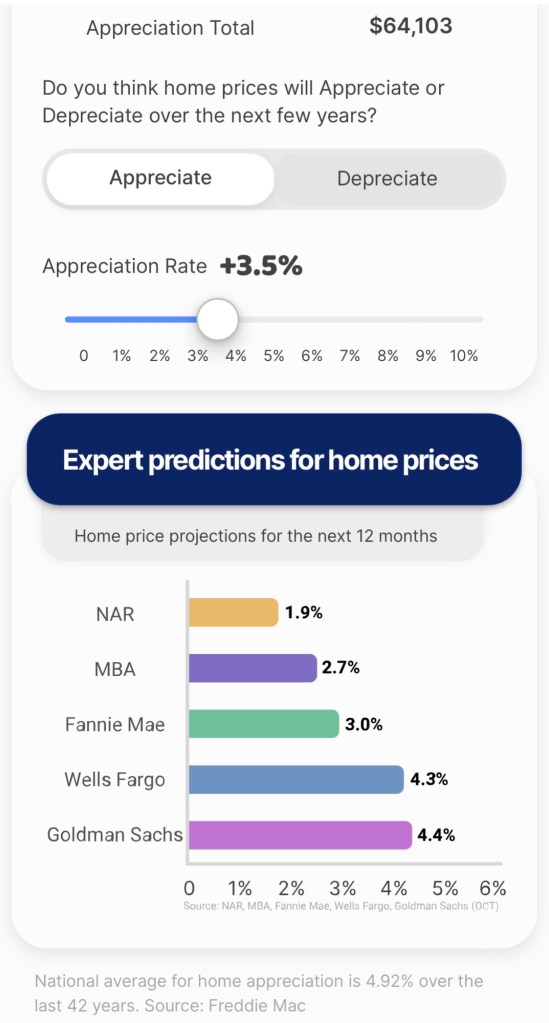
Several economic authorities estimate that real estate values will continue to rise by an average of 3.5% in the next year. This means that homeowner equity will grow. But what if rates are lower in another year or two?
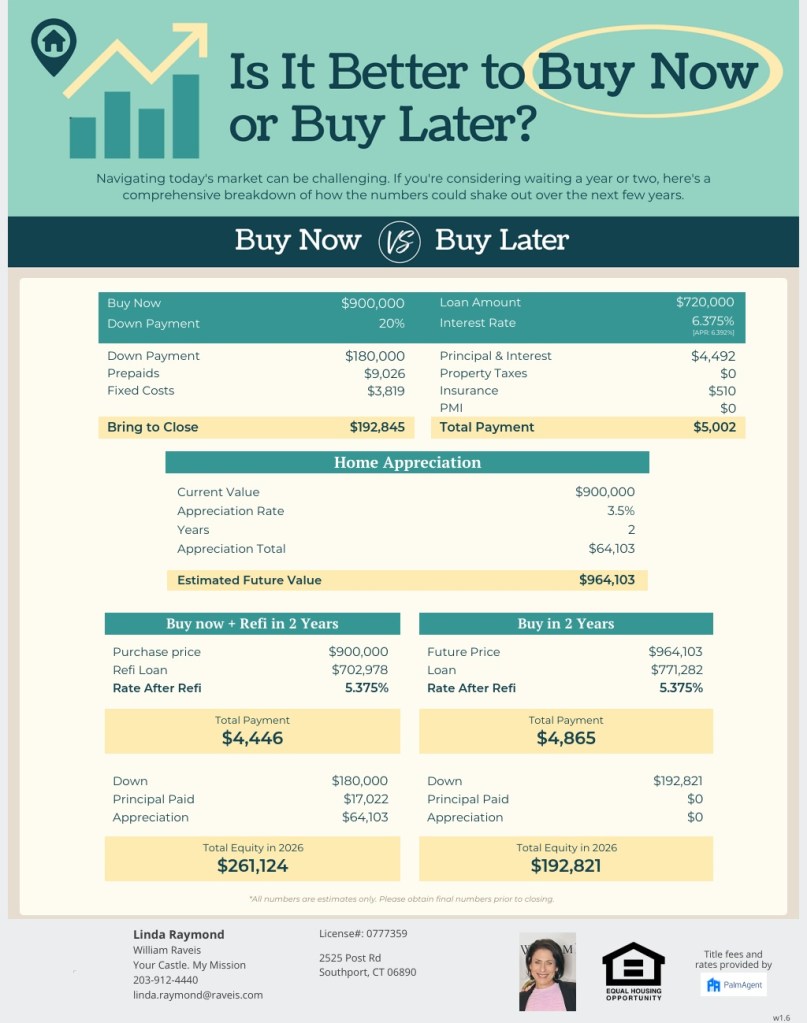
Take a look at the report from my calculator. The example shows a $900,000 home purchase today with 20% down and an interest rate of 6.375% with refinancing in two years to a potential lower interest rate of 5.375%. The calculator compares this approach to waiting two years and purchasing the same home at the lower rate.
Buying now results in a monthly payment of $4,446 and $261,124 in equity after two years, when then you can refinance. After waiting two years, the purchase price is approximately 3.5% higher due to appreciation, resulting in a purchase price of $964,103. The loan for this house may be at a lower rate, but it is now a bigger loan resulting in payments of $414 more each month. Also, this new homeowner has $68,303 less equity than if they had bought the house two years earlier.
If the rates didn’t change, buying later would result in even higher monthly payments due to the larger loan at the higher rate. In this example, purchasing today, would have achieved a lower price, smaller loan, lower monthly payments, and more equity.
I’m happy to calculate different scenarios with varied assumptions for you. Do you think home values will go up or down? What do you think rates will be in two years? What is your home buying budget? What is your dream lifestyle! Reach out to me, and let’s run some scenarios and talk about your plans!
A recent survey found that more than half (52%) of American homeowners have a renovation project planned this year.1 If you’re among them, you know that embarking on home improvements can be both exciting and daunting. According to the survey, the median renovation budget is around $15,000, so you’re probably investing a significant amount—and you’ll want to ensure your project’s success.1 One of the most critical decisions you’ll make is choosing the right contractor to bring your vision to life. However, many homeowners fall into common pitfalls during this process, leading to stress, financial strain, and subpar results.
In this guide, we’ll explore seven mistakes to avoid when hiring a contractor to ensure your project runs smoothly from start to finish.
1. SKIPPING THE RESEARCH PHASE A common mistake homeowners make is rushing into hiring a contractor without proper research. But to ensure the success of your renovation, it’s crucial to take time to meet with multiple candidates and educate yourself on best practices surrounding your project. If you bypass the interview process, you miss the opportunity to evaluate different approaches, pricing, and expertise. This can result in overpaying or hiring someone whose skills and vision do not align with your needs. Neglecting to research the processes and steps involved can also leave you vulnerable. Not only does it make it more difficult to ask the right questions, but you also risk hiring unqualified professionals or settling for subpar work. What To Do Instead:
Educate Yourself — Read up or watch YouTube videos to gain a better understanding of best practices surrounding your project.
Interview Multiple Contractors — Search for and interview at least three contractors who specialize in the type of work you need.
Ask Specific Questions — Inquire about the processes and materials each candidate will utilize.
Seek Recommendations — Get referrals from trusted sources like friends, neighbors, and real estate professionals. We’d be happy to share a list of referrals!
2. CHOOSING BASED SOLELY ON PRICE Once you’ve interviewed candidates and reviewed their proposals, it’s time to choose your favorite. But don’t make the mistake of rushing to the lowest bid. While it’s natural to want to save money, selecting a contractor based entirely on price can be a costly mistake. Extremely low bids may indicate cut corners, subpar materials, or hidden costs that will surface later. According to the National Association of the Remodeling Industry, when evaluating bids, make sure you’re comparing “apples” to “apples” and considering factors like quality, timeline, and scope.2 Are they fully licensed and insured? How long have they been in business? Do they warranty their work? What To Do Instead:
Consider Overall Value — In addition to price, look at experience, reputation, and quality of work.
Ask for Detailed Breakdowns — Understand what’s included and what’s not in each bid.
Be Wary of Low Bids – Bids that are significantly lower than others may be too good to be true.
Invest in Quality — Remember that quality work comes at a fair price, and investing in a reputable contractor can save you money in the long run by avoiding costly mistakes or repairs.
3. NEGLECTING TO CONFIRM CREDENTIALS & INSURANCE When you’ve established a good rapport with a contractor, it’s natural to want to believe the best in them. But neglecting to check references and verify licensing and insurance could come back to haunt you.3 Hiring an untrained or unlicensed contractor puts you at risk for safety and code violations, not to mention shoddy workmanship. Without proper insurance, you could be left footing the bill for costly repairs, legal issues, or even medical bills if someone gets hurt on the job.4 Skipping out on a reference check can be equally problematic. It’s your best opportunity to ensure that their promises and your expectations line up with reality.
What To Do Instead:
Verify Licensing and Insurance — Confirm that the contractor is licensed according to local requirements and verify insurance, including general liability and workers’ compensation coverage.
Check Reviews — Read online reviews and confirm that the business is in good standing with the Better Business Bureau and other relevant trade groups.
Call References — When contacting references, ask questions and request to see photos of the contractor’s completed projects.
Visit Job Sites — If possible, visit a current job site to observe the contractor’s work in progress and interaction with clients.
4. PROCEEDING WITHOUT A WRITTEN AGREEMENT A handshake deal might seem friendly and straightforward, but it’s a recipe for misunderstandings and potential legal issues. Verbal agreements are difficult to enforce and leave room for miscommunication about project scope, timelines, and costs.5 Instead, you should have a signed contract in place before any work begins.3 Paperwork can be tedious, but don’t skip the important step of carefully reading over your contract, asking questions, and pushing back on any terms that make you uncomfortable. Don’t forget to ask for payment receipts and document any change orders or issues that arise throughout the project, as well. What To Do instead:
Insist on a Written Contract — Outline all aspects, including scope, materials, timeline, payment schedule, warranty information, and a process for handling change orders.
Understand and Agree — Don’t sign anything until you fully understand and agree to all terms.
Keep Documentation — Once you’ve made your final payment, request a lien waiver or receipt marked “Paid in Full” to keep on file for legal and tax purposes.6
5. PAYING TOO MUCH UPFRONT Another common misstep is paying a large sum upfront or the full cost of the project before the work is completed. This can leave you vulnerable if the contractor fails to complete the work or disappears with your money. According to the home services platform Angi, deposits typically range between 10% and 33% of the total project cost.7 The remaining payments should be tied to progress milestones outlined in your contract. Construction attorneys caution against paying a greater share of the project cost than the percentage of the work that’s been completed.3 If you end up dissatisfied with the outcome, you’ll have much less leverage if you’ve already paid. What To Do Instead:
Be Cautious — Avoid contractors who demand large upfront payments or cash-only deals.
Establish a Payment Schedule — Tie payments to project milestones and stick to them.
Pay Only Upon Completion — Never pay in full until the project is completed to your satisfaction and all required inspections have been passed.
6. FAILING TO GET NECESSARY PERMITS Skipping the permit process might seem like a way to save time and money, but it can lead to serious consequences. Without the proper permits, you risk running afoul of local building codes and regulations, which could result in fines, forced removal of work, or even legal action.8 Additionally, unpermitted work might compromise the safety and structural integrity of your home, potentially leading to hazardous conditions or diminished resale potential. Homeowners may also find themselves without recourse if issues arise later, as insurance companies often exclude coverage for unpermitted renovations.8 If your community has a homeowners association (HOA), don’t forget to check their requirements, as well. You may need prior approval to make modifications to your home or yard. HOAs have the power to enforce these restrictions with fines, and they can even put a lien on your home—so don’t skip this important step.9 What To Do Instead:
Discuss Permits — Talk about permits and HOA requirements with your contractor before work begins.
Include Permits in the Contract — Ensure that obtaining necessary permits and approvals is part of your contract.
Verify Inspections — Make sure all required inspections are completed during the project.
Keep Records — Keep copies of all permits, HOA approvals, and inspection reports for your records.
7. IGNORING RED FLAGS AFTER THE PROJECT HAS STARTED Sometimes a contractor can check all the right boxes—until the work begins. Unfortunately, red flags that are spotted mid-project can be especially challenging to address. If you’ve already paid a substantial amount or had a portion of your home demolished, you may feel trapped in a bad situation. However, if there are major problems that the contractor is unwilling to address, ignoring them can make things exponentially worse. Don’t be afraid to seek legal or professional advice if issues persist. Taking immediate, informed, and decisive action is crucial to safeguarding your investment and ensuring the project’s ultimate success.10 What To Do Instead:
Review Your Contract — Make sure you thoroughly understand your rights and the agreed-upon terms.
Document Issues — Keep detailed records, including dates, descriptions of problems, photographs of subpar work or materials, and any communications with the contractor.
Communicate Professionally — Arrange a meeting to discuss your concerns, ensuring you remain calm and professional while clearly expressing your expectations.
Request a Resolution Plan — Ask for a plan to address the issues, set a timeline for resolution, and put everything in writing to ensure you’re both on the same page.
Seek Advice — If the contractor is uncooperative or dismissive, consider seeking advice from a legal professional. You could also contact your local licensing board or consumer protection agency for guidance.
BOTTOMLINE Hiring the right contractor is crucial to the success of your home improvement project. By avoiding these common mistakes, you can significantly increase your chances of a smooth and successful renovation experience. Remember, taking the time to thoroughly vet contractors, communicate clearly, and plan carefully will pay off in the long run. Your home is likely your most significant investment, and it deserves the care and attention that comes with making informed, thoughtful decisions about who works on it. If you’d like help finding a contractor or want to know how planned improvements could impact your home’s resale potential, reach out for a free consultation!The above references an opinion and is for informational purposes only. It is not intended to be financial, legal, or tax advice. Consult the appropriate professionals for advice regarding your individual needs. Sources:
If a substantial renovation feels overwhelming and you want to consider a new home that better suits your needs and lifestyle, reach out to me to discuss.
In the dynamic world of real estate, interest rates hold a significant sway over homebuyers’ decisions. Likewise, rates have an impact on homeowners’ ability to sell. As memories of the desirable 2.85% interest rate linger, the current market fluctuations have left potential homeowners pondering their next move. Of course, the unspoken value proposition in all of this is the impact that ‘home’ has on your lifestyle and quality of life. Each person needs to weigh how much they value their lifestyle relative to what they are willing to invest in a new home. In this discussion, we’ll delve into some strategic approaches that can help you navigate this uncertainty while awaiting the (unlikely) return of the coveted 2.85% interest rate.
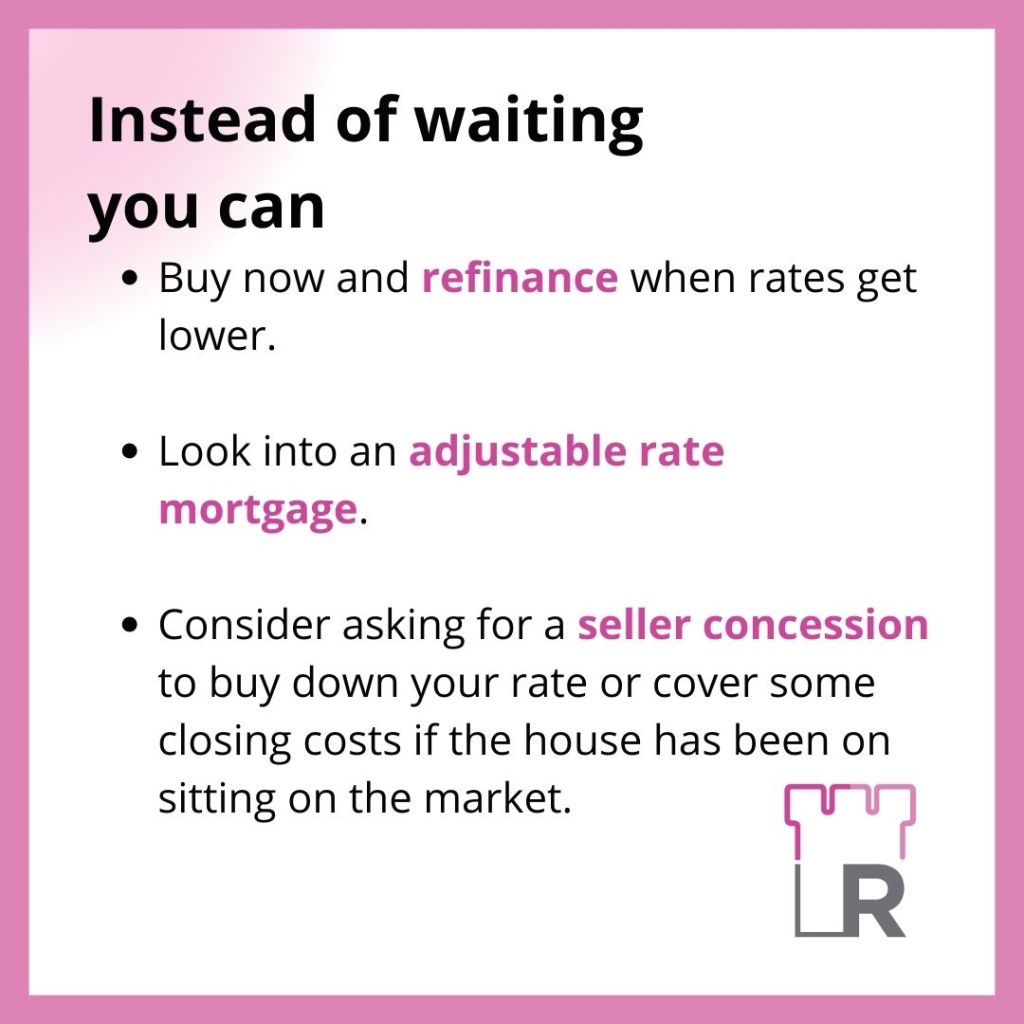
1. Exploring Adjustable Rate Mortgages (ARMs) for Lower Rates: Consider opting for an Adjustable Rate Mortgage (ARM) in a higher interest rate climate. ARMs often begin with a lower rate than fixed-rate mortgages, potentially offering more affordable initial payments. As interest rates are expected to fluctuate, ARMs can be a prudent choice if you anticipate rates to decrease in the future. It’s crucial to understand the terms and associated risks of ARMs before making a decision.
2. Seizing Opportunity: Buying Now and Refinancing for Lower Rates: Rather than endlessly waiting for the ideal 2.85% rate, consider purchasing a home now and exploring refinancing opportunities later. By securing a home at current rates, you can build equity and enjoy the benefits of homeownership. Keep a vigilant eye on market trends to identify the optimal time for refinancing to secure a more favorable rate.
3. Negotiating Seller Concessions for Reduced Costs: Leverage negotiation skills when making an offer on a home by requesting a seller concession. This concession can be used to buy down the interest rate or cover closing costs. Keep in mind, that sellers typically have more leverage than buyers in the current market, but if a home has been lingering on the market longer than the average market time, the homeowner might be willing to work with you for a win-win agreement. This approach provides a means to mitigate the impact of higher interest rates, enhancing short-term affordability and financial flexibility.
4. Diversifying Investment Strategies: Exploring Real Estate Investment: For those hesitant about primary homeownership due to interest rates, diversifying into real estate investment can be an attractive alternative. Options like rental properties and real estate investment trusts (REITs) allow you to benefit from market dynamics while potentially bolstering your investment portfolio. Thorough research is essential to navigate each avenue’s nuances and risks.
5. Seeking Expert Guidance: Partnering with Financial Professionals: To effectively navigate the intricate interplay of interest rates and real estate, consult financial advisors, mortgage experts, and real estate professionals. Their insights and tailored advice can help you make informed decisions aligned with your financial goals and market projections.
Conclusion: In the pursuit of the elusive 2.85% interest rate, remember that the real estate market’s complexity extends beyond rates alone. By exploring ARM options, capitalizing on current opportunities and planning for future refinancing, negotiating for seller concessions, and diversifying investment strategies, you can confidently navigate today’s real estate landscape. Stay informed, seek professional counsel, and make choices tailored to your financial situation and aspirations.
I took a continuing ed course taught by Birgit Anich of BA Staging and Interiors last week. I have taken staging classes before, but I didn’t realize that such a strong positive psychological impact can be achieved when applying staging strategy and design techniques.
When you walk into a home, you may feel nothing. You might even feel an aversion. Or your heart may skip a beat, and you experience a “chemistry”, a feeling of excitement, or joy.
We all make decisions based on emotion. We then back up our emotions with fact. Therefore, as a homeowner, when you prepare your house for sale, ensuring your buyers experience a “wow” as soon as they arrive and walk in should be part of your investment in achieving your top dollar sale.
When you put your house on the market, you want buyers to feel the love when they walk in.
Here are four guiding concepts:
Everything has a place and a purpose! If it doesn’t, take it out.
Curb appeal is key. This is the first impression. Every home needs a wow-factor, so incorporate something to evoke a positive emotion even before entering the home.
Everything the buyer sees tells a story, so make it the story you want to tell. For example, if closets are jam-packed, it tells the buyer there might not be enough storage. Closets should ideally be 70% full and arranged by color.
Create lifestyle moments. Create the idea of an “aspirational lifestyle”. An example of this is the big soaking tub. Most people never use them, but they love the idea of it when they see it! An alternative can be to have a big coffee table book open to a page showing a luxurious vacation spot or collectible cars.
What are some of the strategies?
Feature the features. Guide the eye toward what you want to showcase. Any custom elements should be featured such as a new kitchen. All assets should be featured, such as great views, fireplaces, and vaulted ceilings.
Make sure there’s no “wasted space”. Clearly define the use of all space and give it a purpose. Be sure to separate adult space from kids’ space.
Minimalize. Use a “less is more” approach.
Create “memory points”. For example, after seeing four homes, someone might say, “Yes, I remember that house. It’s the one with the pink cushions!”
Out with the old, in with the new. Refresh items and elements that give a dated or tired impression. For example, swapping out dated light fixtures can make a huge difference in the impression it makes!
Appeal to the senses. Clean and fresh is key. There is actually a special type of light bulb that can eliminate stubborn odors, such as from pets. Don’t over-do-it with strong scents from candles or oils. Lighting is important too. Be sure to avoid using bulbs with cool lighting.
Texture, color, placement, materials, metals, mirrors, vignettes, and ‘signs of life’ are just a few elements Birgit employs for her strategy. Here are some tricks of the trade!
Proper lighting wattage and color is important. Use warm lighting with 2700-3000 Kelvin in the living room. A bit cooler lighting in the kitchen is okay, 3000+ Kelvin.
Furniture placement is important. The heaviest piece of furniture should be on the wall opposite the entrance to the room. Make sure there is at least three feet clearance to walk around furniture, especially tables, but no more than four feet.
Use big area rugs to anchor furniture in a room and give it a connected, cohesive, luxurious look. For luxury spaces, have a big rug with all furnishings set completely on it. For more informal spaces, use a big rug with furnishings off-set or extending off the edges.
Coordinate colors.
Balance rooms with symmetry.
Group accessories in sets of three and five (odd numbers).
Repeat design themes throughout the home.
Use mirrors as a design element to reflect light, reflect pretty views opposite them, and let the buyers see themselves in the space!
Incorporate “signs of life“, like plants to add a warmth and an organic component to the space.
Add pops of color to make space memorable and help guide the focus to where you want it.
Set accessories on angles so they are not too predictable looking.
Create “special moments“. Use vignettes to suggest a moment in time and create a lifestyle feel. For example, you can display a decorative board game on a coffee table and have a couple of the pieces out in play as though people were just playing.
Mix metals. For example use a black metal with a gold metal to add interest and variation.
Add “plush” (textures). For example, add fur seat cushions or open a lively book to a specific page and put it on a desk or coffee table.
Use lighting to center the space.
In a gourmet kitchen, use lifestyle accessories.
In bedrooms, neutralize bedding with whites for a fresh clean impression.
Mix patterns and solids.
Use timeless glass.
I bet you can’t wait to try a few of these ideas in your own home! Here are some pictures to get the juices flowing. But if you are thinking about making a move and feel overwhelmed by everything you have do, don’t worry, I’m here to get you the resources and guide the process to get you there. Just keep your eye on the end game, and we will be there soon!
When your clients say they won’t bid on the house until hell freezes over or HGTV gives them a free makeover. 🧐
Although buyers might not have the same level of negotiating power of yesteryear, there is still some opportunity to negotiate on a case by case basis. It depends on
🟠how much demand there is for the property,
🟠the motivation level of the seller, and
🟠how much concession the buyer is asking for.
If you are a buyer who will only consider a jackpot deal, you could luck out, or you could be waiting a very long time. 🤷♀️
Just kidding (about the photo, not the commentary)!
My clients just came across the picture and sent it to me. It looks so ‘retro’ I had to have some fun with it. I wasn’t waiting for my clients to decide on an offer. They had actually already bought the house and were about to cash in on a free makeover from HGTV when we filmed the show, HGTV House Hunters Renovations. We were on a break during filming in the kitchen. Below is their gorgeous renovated kitchen thanks to HGTV. Sometimes things just work out perfectly! 🏡 🌳 🌞
Here are a couple more snapshots from behind the scenes at some other properties we browsed for the show.
If you have questions about the market, moving process, or would like to talk about your plans. Drop me a note below!




























 Fairfield and Westport CT Real Estate Guide