Every spring and early summer, something remarkable happens along Connecticut’s shoreline. As the tides rise, thousands of horseshoe crabs emerge under the cover of darkness to continue a ritual that has remained largely unchanged for hundreds of millions of years.
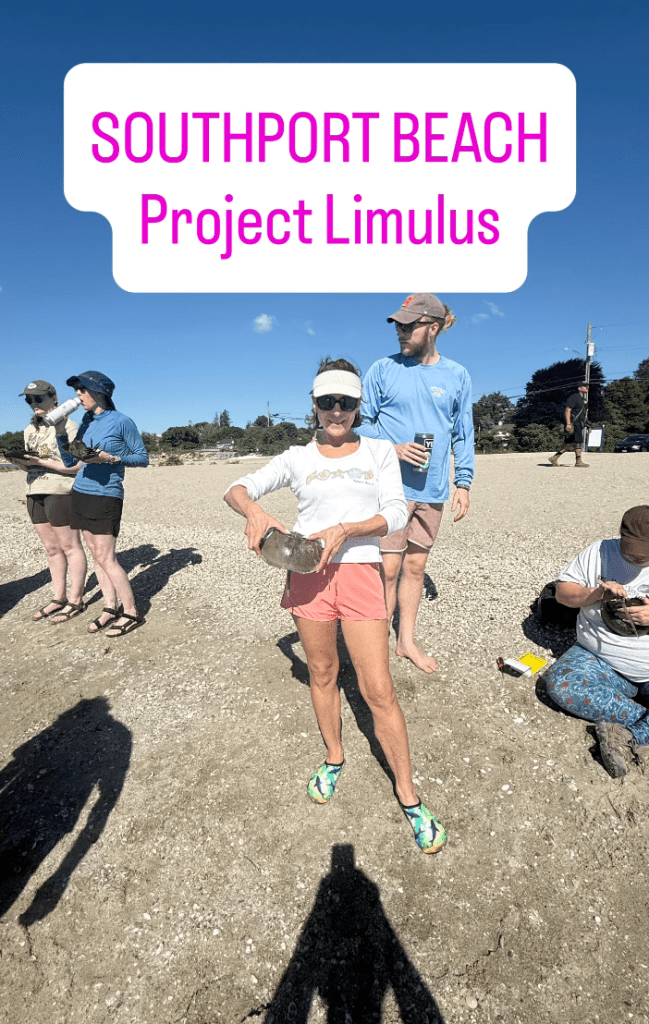
The past two summers, I had the opportunity to volunteer with Project Limulus at Southport Beach CT, helping researchers safely tag horseshoe crabs as part of an ongoing conservation effort. Spending a morning alongside scientists, volunteers, and families gave me an even greater appreciation for these extraordinary animals and the role they play in keeping Long Island Sound healthy.
As a coastal Connecticut Realtor specializing in Fairfield, Southport, and Westport, I believe one of the greatest privileges of living here is being surrounded by an incredible coastal ecosystem. Protecting it helps preserve the quality of life that makes our shoreline communities so special.
Here are ten things you may not know about horseshoe crabs.
1. Despite Their Appearance, They Can’t Bite or Pinch You
Horseshoe crabs often surprise people with their armored shells and long pointed tails. Fortunately, they’re completely harmless to humans.
They have no teeth, no stingers, and no claws capable of pinching. Their tail, called a telson, isn’t a weapon—it’s simply a tool they use to flip themselves over if waves leave them upside down.
2. They’ve Been Around Since Before the Dinosaurs
Horseshoe crabs have survived for more than 445 million years, making them one of Earth’s oldest living species.
They’ve lived through multiple mass extinctions, the age of dinosaurs, and even the Ice Age. Few living creatures can claim such an extraordinary history.
3. The Males Really Do Wear “Boxing Gloves”
One of the easiest ways researchers identify males and females is by looking at their front pincers.
Male horseshoe crabs have distinctive hook-shaped claws that resemble tiny boxing gloves. These specialized claws allow the male to hold onto the female during spawning as she lays eggs along the shoreline.
Once you know what to look for, it’s surprisingly easy to tell them apart.
4. They’re Living Ecosystems
A single horseshoe crab supports an entire community of marine life.
Their shells often become home to algae, barnacles, mussels, slipper shells, and other organisms, creating miniature ecosystems wherever they travel.
In many ways, they’re not just part of the ecosystem—they’re ecosystems themselves.
5. Their Eggs Feed Thousands of Migrating Birds
Each female can lay tens of thousands of eggs during spawning season.
Those nutrient-rich eggs become a vital food source for migrating shorebirds traveling thousands of miles along the Atlantic Flyway. Without healthy horseshoe crab populations, many bird species would struggle to complete their migrations successfully.
Healthy beaches support healthy wildlife.
6. Their Blood Has Saved Countless Human Lives
One of the most remarkable facts about horseshoe crabs is that their blue blood has transformed modern medicine.
Their blood contains specialized cells that clot instantly in the presence of harmful bacterial toxins. Scientists developed a test using this natural reaction that helps ensure vaccines, intravenous medications, implantable medical devices, and many injectable pharmaceuticals are free from dangerous bacterial contamination before reaching patients.
Research involving horseshoe crabs has also contributed to advances in vision science and has inspired innovations used in specialized surgical materials and wound care.
7. Their Eyes Are Unlike Almost Any Other Animal
Horseshoe crabs have multiple eyes positioned around their bodies, each serving different purposes.
Their unique visual system has been studied for decades and has expanded scientists’ understanding of how vision and the nervous system process light and movement—research that has influenced both medicine and neuroscience.
8. Their Population Has Been Declining
Although horseshoe crabs have survived for hundreds of millions of years, modern challenges have put increasing pressure on their populations.
Habitat loss, shoreline development, harvesting, and climate-related changes have all contributed to population declines in parts of their range.
That’s why monitoring and conservation efforts are so important.
9. Project Limulus Has Been Protecting Long Island Sound for Decades
Project Limulus began in 1997 to better understand and conserve horseshoe crab populations throughout Long Island Sound.
Since then, volunteers and researchers have tagged approximately 98,000 horseshoe crabs, collecting valuable information about migration patterns, longevity, spawning behavior, and population trends.
One of the project’s greatest strengths is its commitment to public education. Community volunteers—including local residents like me—work alongside scientists to collect meaningful data while learning firsthand why these remarkable animals matter.
Every tagged horseshoe crab contributes another piece to a much larger puzzle.
The information collected through Project Limulus helps scientists make informed conservation decisions that benefit wildlife, coastal habitats, and ultimately everyone who enjoys Long Island Sound.
Living along Connecticut’s shoreline means being stewards of an extraordinary environment. Whether you’re walking Southport Beach, kayaking in the Sound, or simply enjoying the beauty of our coastline, horseshoe crabs are quietly playing an essential role beneath the surface.
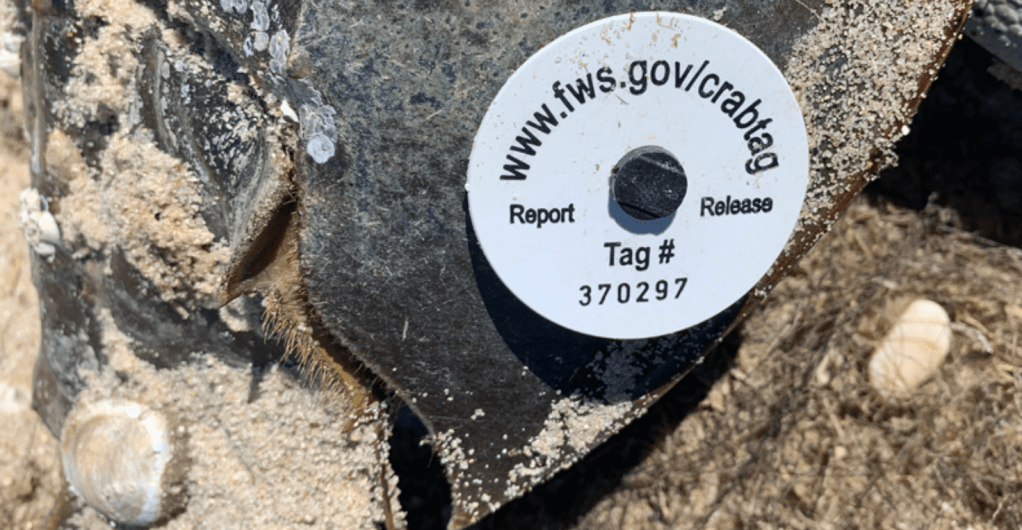
Horseshoe crabs are tagged in NY, CT, MA, and RI. They tend to travel long distances!
If you find a horseshoe crab with a white disc please call 1-888-LIMULUS (1-888-546-8587) to report the tag number, location (specific beach), date you found the crab, and if the crab was alive or dead.
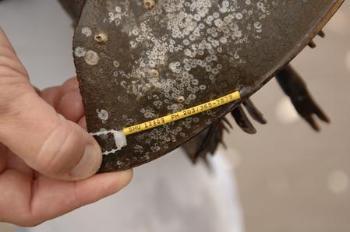
If you see a yellow cinch tags call 203-365-7577 to report the tag number, location (which beach), date you found the crab, and if the crab was alive or dead.
Please return live crabs to the water.
I’m grateful to have participated in this year’s Project Limulus event and look forward to volunteering again. Experiences like these remind me why I’m so passionate about our coastal communities—not only for the beautiful homes they offer, but also for the incredible natural resources that make Fairfield, Southport, and Westport such special places to live.
Have you ever spotted horseshoe crabs along Connecticut’s shoreline? I’d love to hear about your experience—or better yet, consider volunteering at a future Project Limulus event. It’s a memorable way to give back to one of our region’s most remarkable natural treasures.
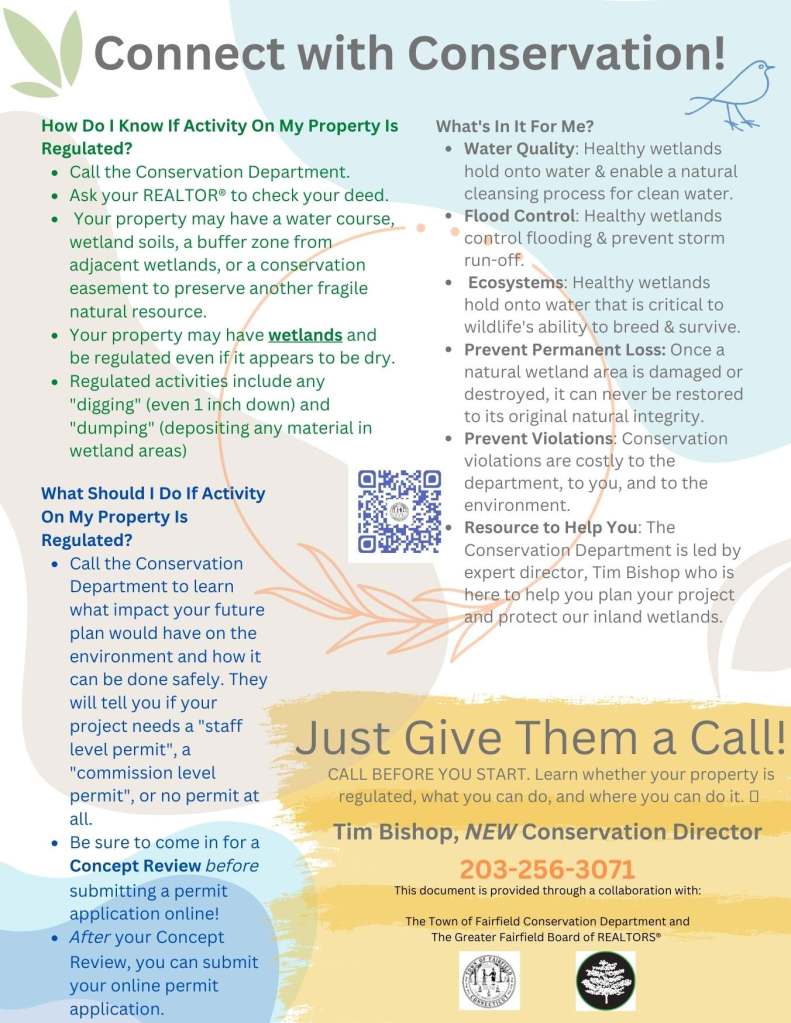
During a recent meeting of the Greater Fairfield Board of Realtors, a panel of town officials from several departments presented updates and information for discussion among the group. I was struck by the new Conservation Director’s announcement that the volume of inland wetland violations has skyrocketed recently with all the new homeowners moving into town and being unaware about the presence and importance of wetlands. He asked if we could help him get the word out to people.
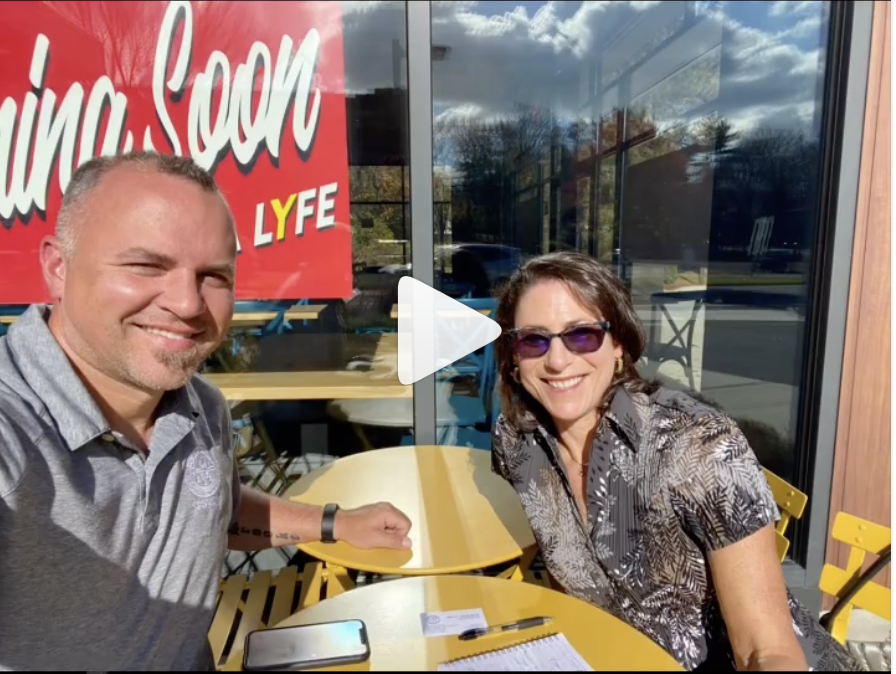
So (on an unseasonably hot day in November!) I met with Fairfield’s new Conservation Director, Tim Bishop over coffee to talk about how I can help homeowners in town learn how to protect our precious wetlands. Tim is an expert environmentalist with almost two decades of experience. He is an excellent resource for our town and truly wants to collaborate with homeowners to help them get their home improvements done while protecting our fragile natural resource, the inland wetland areas.
When meeting with Tim, I learned that most people are not aware of the importance of protecting wetlands. I learned that protecting our inland wetlands is critical to controlling flooding and stormwater run-off, maintaining our water quality, and preserving natural ecosystems that need still (vs. flowing) water to breed and live. Healthy wetland areas hold onto water which allows a natural cleaning process to occur and provides the environment necessary for wildlife survival, while controlling flooding.
People don’t realize that their actions could be permanently destroying this critical natural resource, and they don’t realize that what they do in their yard impacts other people. So I assembled the information below to address the key issues and also put it in a handout for people to use and share.
HOW DO I KNOW IF MY PROPERTY IS REGULATED?
Call the Conservation Department. Ask your REALTOR® to check your deed.
Your property may have a water course, wetland soils, a buffer zone from adjacent wetlands, or a conservation easement to preserve another fragile natural resource.
Your property may have wetlands and be regulated even if it appears to be dry. Regulated activities include any “digging” (even 1 inch down) and “dumping” (depositing any material in wetland areas)
WHAT SHOULD I DO IF ACTIVITY ON MY PROPERTY IS REGULATED?
Call the Conservation Department to learn what impact your future plan would have on the environment and how it can be done safely. They will tell you if your project needs a “staff level permit”, a “commission level permit”, or no permit at all.
Be sure to come in for a Concept Review before submitting a permit application online! After your Concept Review, you can submit your online permit application.
WHAT’S IN IT FOR ME?! Water Quality: Healthy wetlands hold onto water & enable a natural cleansing process for clean water. Flood Control: Healthy wetlands control flooding & prevent storm run-off.
Ecosystems: Healthy wetlands hold onto water that is critical to wildlife’s ability to breed & survive. Prevent Permanent Loss: Once a natural wetland area is damaged or destroyed, it can never be restored to its original natural integrity. Prevent Violations: Conservation violations are costly to the department, to you, and to the environment.
Resource to Help You: The Conservation Department is led by expert director, Tim Bishop who is here to help you plan your project and protect our inland wetlands.
Just Give Them a Call!
CALL BEFORE YOU START. Learn whether your property is regulated, what you can do, and where you can do it.
Tim Bishop, NEW Conservation Director 203-256-3071
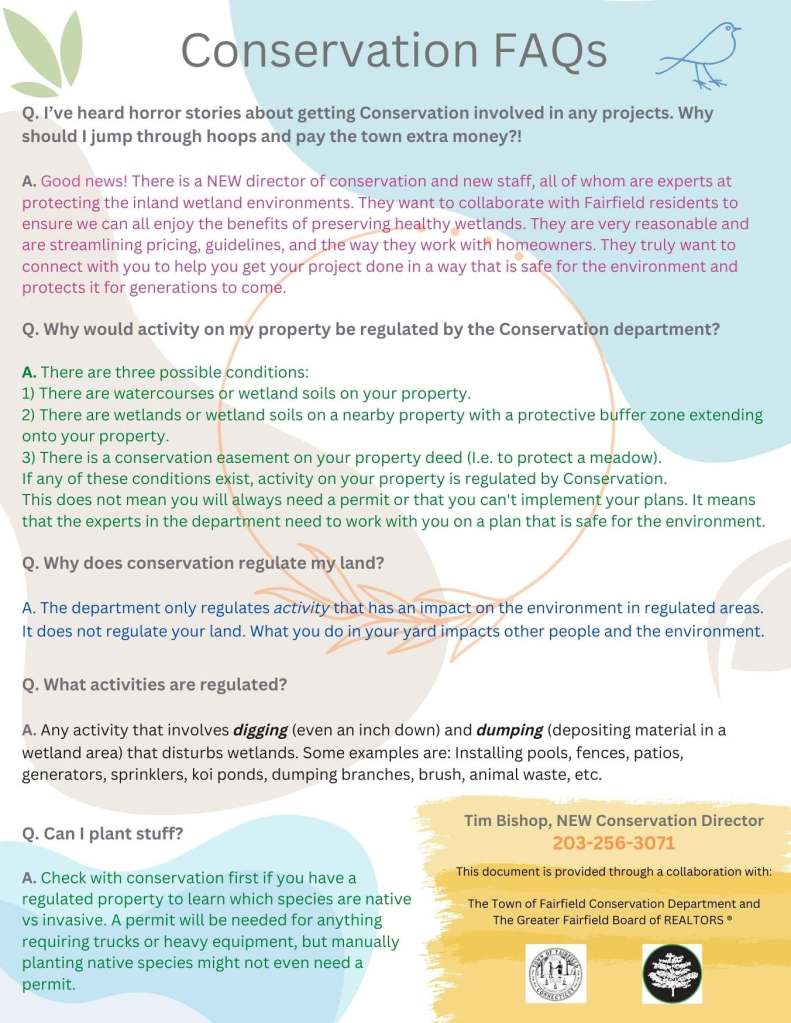
FAQS:
Q. I’ve heard horror stories about getting Conservation involved in any projects. Why should I jump through hoops and pay the town extra money?!
A. Good news! There is a NEW director of conservation and new staff, all of whom are experts at protecting the inland wetland environments. They want to collaborate with Fairfield residents to ensure we can all enjoy the benefits of preserving healthy wetlands. They are very reasonable and are streamlining pricing, guidelines, and the way they work with homeowners. They truly want to connect with you to help you get your project done in a way that is safe for the environment and protects it for generations to come.
Q. Why would activity on my property be regulated by the Conservation department?
A. There are three possible conditions: 1) There are watercourses or wetland soils on your property. 2) There are wetlands or wetland soils on a nearby property with a protective buffer zone extending onto your property. 3) There is a conservation easement on your property deed (I.e. to protect a meadow). If any of these conditions exist, activity on your property is regulated by Conservation. This does not mean you will always need a permit or that you can’t implement your plans. It means that the experts in the department need to work with you on a plan that is safe for the environment.
Q. Why does conservation regulate my land?
A. The department only regulates activity that has an impact on the environment in regulated areas. It does not regulate your land. What you do in your yard impacts other people and the environment.
Q. What activities are regulated?
A. Any activity that involves digging (even an inch down) and dumping (depositing material in a wetland area) that disturbs wetlands. Some examples are: Installing pools, fences, patios, generators, sprinklers, koi ponds, dumping branches, brush, animal waste, etc.
Q. Can I plant stuff?
A. Check with conservation first if you have a regulated property to learn which species are native vs invasive. A permit will be needed for anything requiring trucks or heavy equipment, but manually planting native species might not even need a
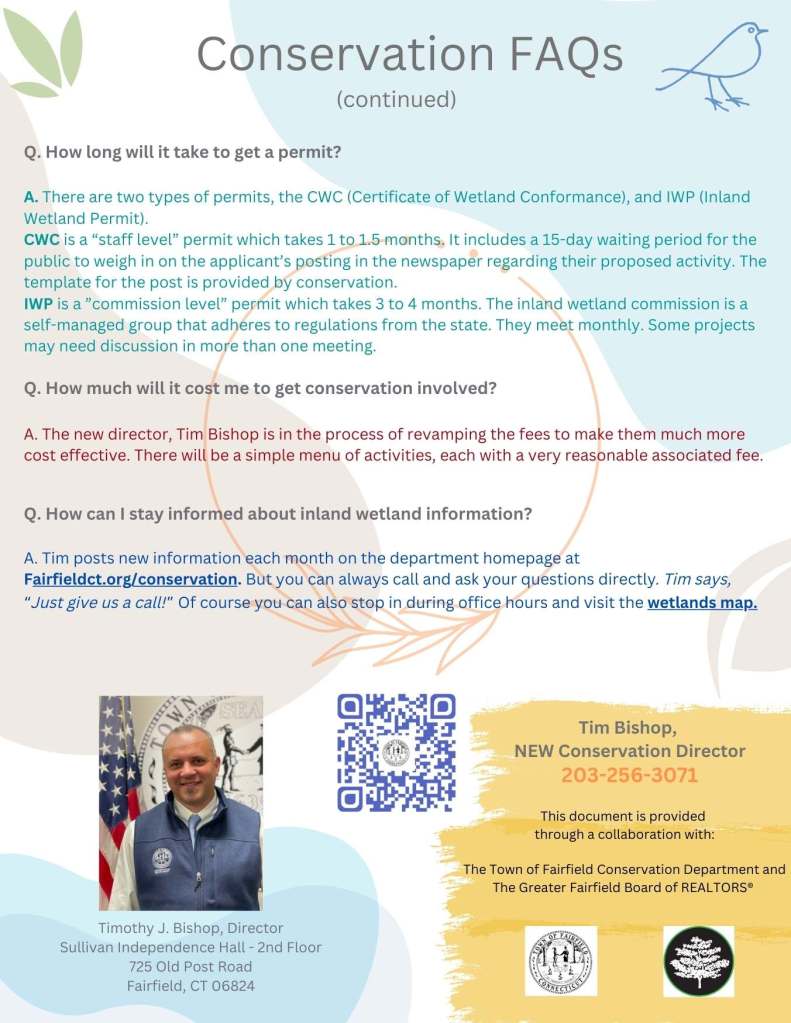
Q. How long will it take to get a permit?
A. There are two types of permits, the CWC (Certificate of Wetland Conformance), and IWP (Inland Wetland Permit). CWC is a “staff level” permit which takes 1 to 1.5 months. It includes a 15-day waiting period for the public to weigh in on the applicant’s posting in the newspaper regarding their proposed activity. The template for the post is provided by conservation.
IWP is a ”commission level” permit which takes 3 to 4 months. The inland wetland commission is a self-managed group that adheres to regulations from the state. They meet monthly. Some projects may need discussion in more than one meeting.
Q. How much will it cost me to get conservation involved?
A. The new director, Tim Bishop is in the process of revamping the fees to make them much more cost effective. There will be a simple menu of activities, each with a very reasonable associated fee.
Q. How can I stay informed about inland wetland information?
A. Tim posts new information each month on the department homepage at Fairfieldct.org/conservation. But you can always call and ask your questions directly. Tim says, “Just give us a call!” Of course you can also stop in during office hours and visit the wetlands map.
If you are thinking of buying and/or selling a property and have questions, you can reach out to me below.





 Fairfield and Westport CT Real Estate Guide