

During a recent meeting of the Greater Fairfield Board of Realtors, a panel of town officials from several departments presented updates and information for discussion among the group. I was struck by the new Conservation Director’s announcement that the volume of inland wetland violations has skyrocketed recently with all the new homeowners moving into town and being unaware about the presence and importance of wetlands. He asked if we could help him get the word out to people.

So (on an unseasonably hot day in November!) I met with Fairfield’s new Conservation Director, Tim Bishop over coffee to talk about how I can help homeowners in town learn how to protect our precious wetlands. Tim is an expert environmentalist with almost two decades of experience. He is an excellent resource for our town and truly wants to collaborate with homeowners to help them get their home improvements done while protecting our fragile natural resource, the inland wetland areas.
When meeting with Tim, I learned that most people are not aware of the importance of protecting wetlands. I learned that protecting our inland wetlands is critical to controlling flooding and stormwater run-off, maintaining our water quality, and preserving natural ecosystems that need still (vs. flowing) water to breed and live. Healthy wetland areas hold onto water which allows a natural cleaning process to occur and provides the environment necessary for wildlife survival, while controlling flooding.
People don’t realize that their actions could be permanently destroying this critical natural resource, and they don’t realize that what they do in their yard impacts other people. So I assembled the information below to address the key issues and also put it in a handout for people to use and share.
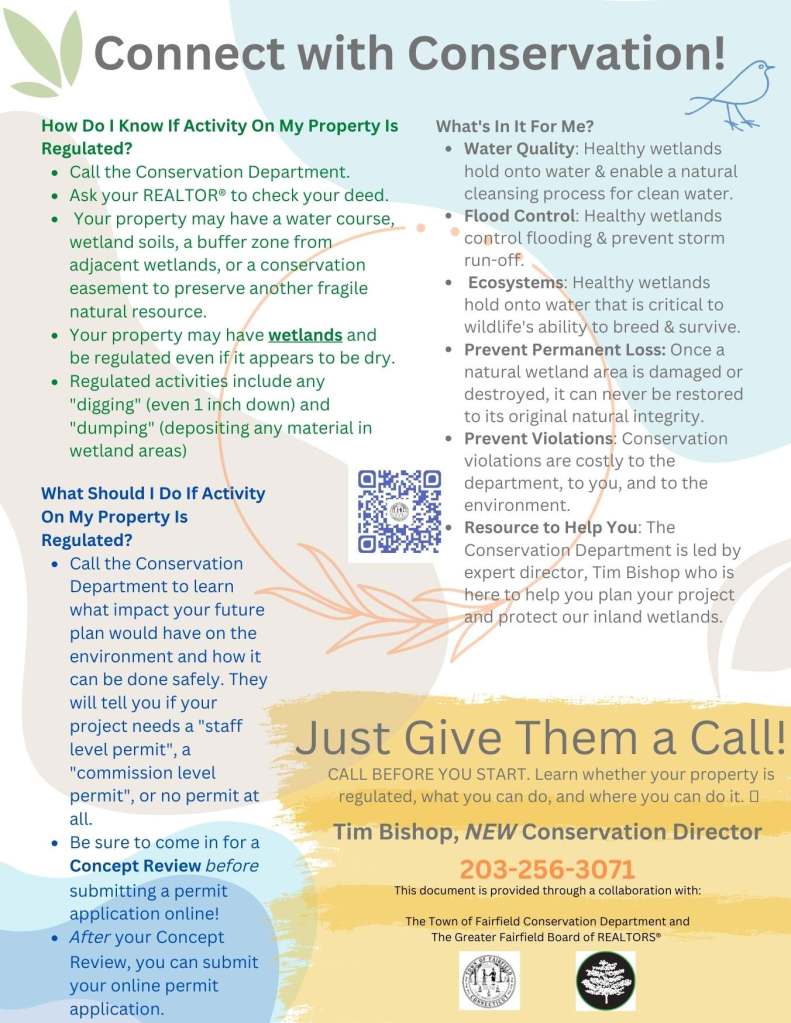
HOW DO I KNOW IF MY PROPERTY IS REGULATED?
Call the Conservation Department.
Ask your REALTOR® to check your deed.
Your property may have a water course, wetland soils, a buffer zone from adjacent wetlands, or a conservation easement to preserve another fragile natural resource.
Your property may have wetlands and be regulated even if it appears to be dry. Regulated activities include any “digging” (even 1 inch down) and “dumping” (depositing any material in wetland areas)
WHAT SHOULD I DO IF ACTIVITY ON MY PROPERTY IS REGULATED?
Call the Conservation Department to learn what impact your future plan would have on the environment and how it can be done safely. They will tell you if your project needs a “staff level permit”, a “commission level permit”, or no permit at all.
Be sure to come in for a Concept Review before submitting a permit application online! After your Concept Review, you can submit your online permit application.
WHAT’S IN IT FOR ME?!
Water Quality: Healthy wetlands hold onto water & enable a natural cleansing process for clean water. Flood Control: Healthy wetlands control flooding & prevent storm run-off.
Ecosystems: Healthy wetlands hold onto water that is critical to wildlife’s ability to breed & survive. Prevent Permanent Loss: Once a natural wetland area is damaged or destroyed, it can never be restored to its original natural integrity. Prevent Violations: Conservation violations are costly to the department, to you, and to the environment.
Resource to Help You: The Conservation Department is led by expert director, Tim Bishop who is here to help you plan your project and protect our inland wetlands.
Just Give Them a Call!
CALL BEFORE YOU START. Learn whether your property is regulated, what you can do, and where you can do it.
Tim Bishop, NEW Conservation Director 203-256-3071
FAQS:
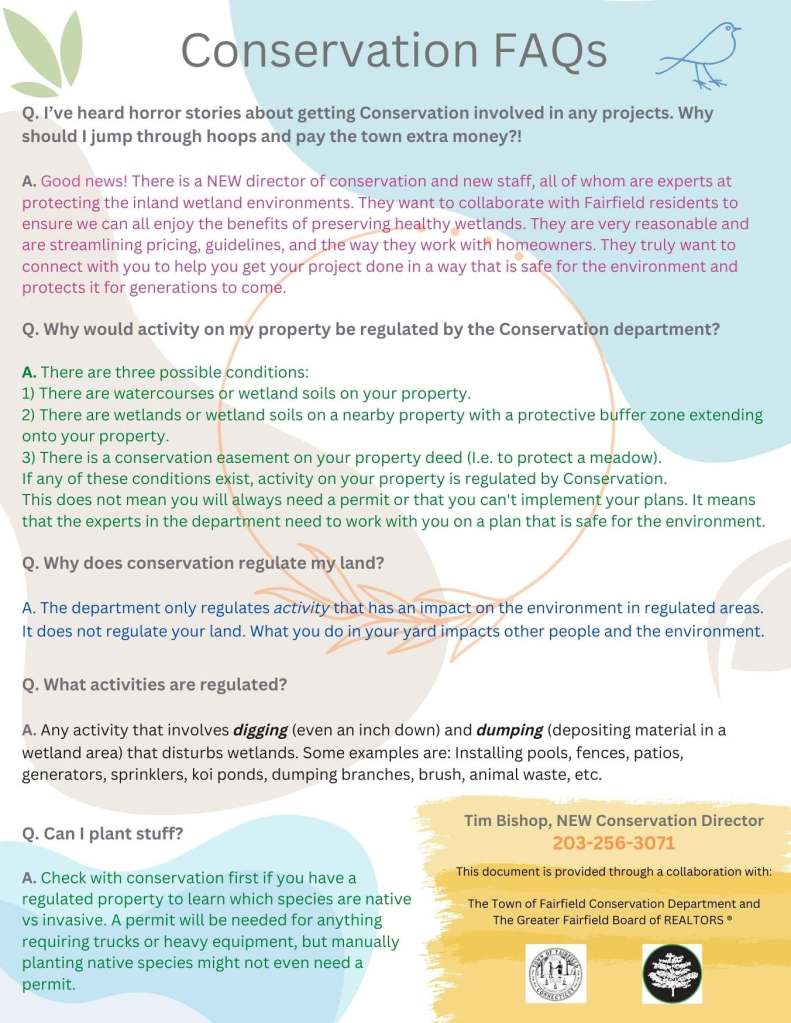
Q. I’ve heard horror stories about getting Conservation involved in any projects. Why should I jump through hoops and pay the town extra money?!
A. Good news! There is a NEW director of conservation and new staff, all of whom are experts at protecting the inland wetland environments. They want to collaborate with Fairfield residents to ensure we can all enjoy the benefits of preserving healthy wetlands. They are very reasonable and are streamlining pricing, guidelines, and the way they work with homeowners. They truly want to connect with you to help you get your project done in a way that is safe for the environment and protects it for generations to come.
Q. Why would activity on my property be regulated by the Conservation department?
A. There are three possible conditions:
1) There are watercourses or wetland soils on your property.
2) There are wetlands or wetland soils on a nearby property with a protective buffer zone extending onto your property.
3) There is a conservation easement on your property deed (I.e. to protect a meadow).
If any of these conditions exist, activity on your property is regulated by Conservation.
This does not mean you will always need a permit or that you can’t implement your plans. It means that the experts in the department need to work with you on a plan that is safe for the environment.
Q. Why does conservation regulate my land?
A. The department only regulates activity that has an impact on the environment in regulated areas. It does not regulate your land. What you do in your yard impacts other people and the environment.
Q. What activities are regulated?
A. Any activity that involves digging (even an inch down) and dumping (depositing material in a wetland area) that disturbs wetlands. Some examples are: Installing pools, fences, patios, generators, sprinklers, koi ponds, dumping branches, brush, animal waste, etc.
Q. Can I plant stuff?
A. Check with conservation first if you have a regulated property to learn which species are native vs invasive. A permit will be needed for anything requiring trucks or heavy equipment, but manually planting native species might not even need a
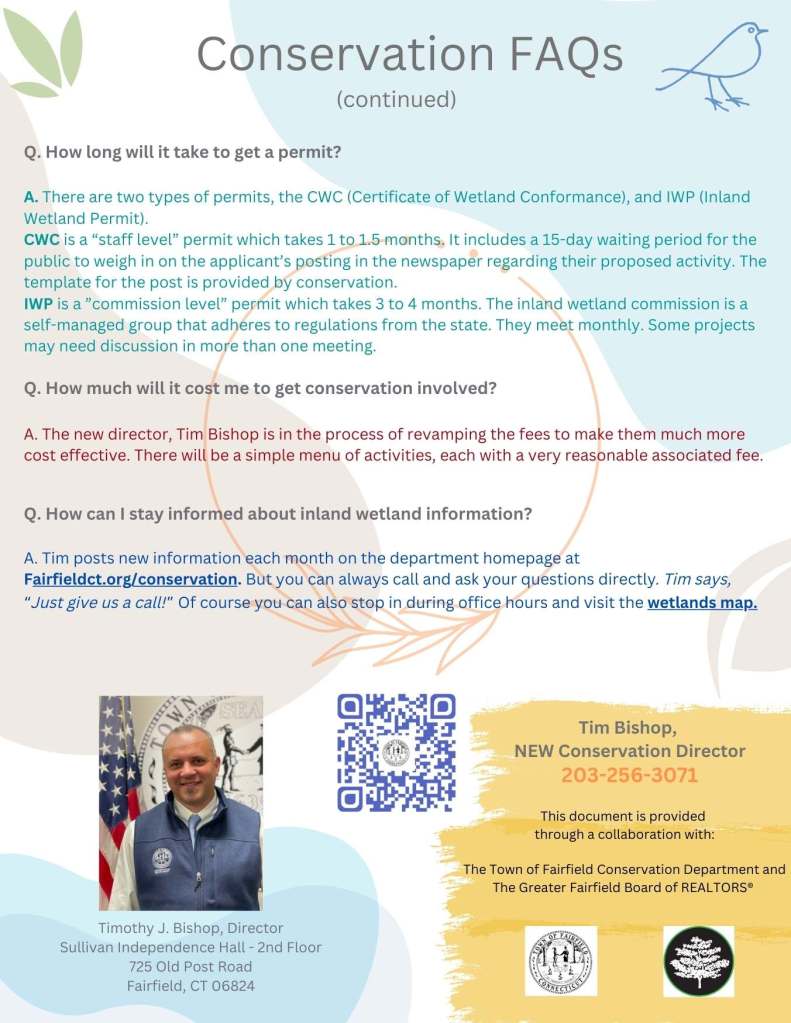
Q. How long will it take to get a permit?
A. There are two types of permits, the CWC (Certificate of Wetland Conformance), and IWP (Inland Wetland Permit).
CWC is a “staff level” permit which takes 1 to 1.5 months. It includes a 15-day waiting period for the public to weigh in on the applicant’s posting in the newspaper regarding their proposed activity. The template for the post is provided by conservation.
IWP is a ”commission level” permit which takes 3 to 4 months. The inland wetland commission is a self-managed group that adheres to regulations from the state. They meet monthly. Some projects may need discussion in more than one meeting.
Q. How much will it cost me to get conservation involved?
A. The new director, Tim Bishop is in the process of revamping the fees to make them much more cost effective. There will be a simple menu of activities, each with a very reasonable associated fee.
Q. How can I stay informed about inland wetland information?
A. Tim posts new information each month on the department homepage at Fairfieldct.org/conservation. But you can always call and ask your questions directly. Tim says, “Just give us a call!” Of course you can also stop in during office hours and visit the wetlands map.
If you are thinking of buying and/or selling a property and have questions, you can reach out to me below.


 Fairfield and Westport CT Real Estate Guide