

You probably don’t have to worry about replacing your driveway anytime soon.
But if you did….would you ever think of replacing it with something other than asphalt?
It doesn’t occur to most of us to seek out “green” alternatives. Yet, there are a growing array of options for ways to preserve our environment and reduce carbon emissions that cause dangerous global warming and increasingly extreme and destructive weather events.
“Asphalt and concrete are old school bad boys”, -Stephen Treffinger in an article from MYND, a real estate investing firm.
Everyone has asphalt driveways. What’s wrong with asphalt?
Asphalt and concrete are not sustainable. The main component of asphalt is petroleum, which is a limited resource found beneath the earth’s surface. The process of extracting it consumes large amounts of energy and also disrupts the surrounding environment. In fact the extraction process is thought to be the cause of earthquakes in Oklahoma according to Aexel Corporation. The asphalt and its production release dangerous and toxic carbon emissions and VOCs (Volatile Organic Compounds) into the atmosphere. Blacktop then absorbs and re-emits the sun’s heat back into the air causing higher temperatures, whereas natural landscape materials do not. And last, but not least, the pavement (along with all impermeable surfaces) threatens our water supply by preventing natural filtration of water through the ground. Instead it causes water contaminated by the asphalt and other debris to run-off the hard surface and mix with the sewage drainage system before ending up back into our rivers.
What can be done?
Fairfield Connecticut has a plan called Resiliency for Downtown Fairfield Using Green Infrastructure (GI). The plan says-
The overriding philosophy of GI is to emulate the way natural systems manage water. For instance, runoff can be thought of as a “waste” of water in a natural landscape. A natural landscape tends to conserve water; it is a natural cooling system, a natural material/food delivery system, a cleansing system, and a cell structural maintenance system among other things. The water cycle is nature’s way of collecting, storing, and timing the redistribution of water across landscapes.
Runoff is water that is not captured by upland landscapes for their needs.
GI describes the processes of using various techniques that seek to mimic the soil’s natural ability to infiltrate runoff. This is important as climate change projections for New England generally predict warmer temperatures with increasingly strong storms and high precipitation events. This can cause the seemingly paradoxical effects of increased drought from the high temperatures while also increasing the risk of flooding from the strong storm events. GI can help negate both consequences by taking water that would otherwise runoff, swelling brooks and rivers, and instead allowing that water to infiltrate into the ground or be captured and used directly.
Is green the new black? 🌱
Asphalt recycling and more porous alternatives can be used until better solutions become readily available. But here are some methods for greening our driveways for a more eco-conscious future, shared from MYND.
Gravel – Pros: It is inexpensive at $1 to $2 per square foot, can be locally sourced, and is very porous, making it a highly eco-friendly, green option. Cons: It could pose a challenge to plowing in the winter.
Seashells 🐚 – Pros: The shells can be collected without harming the shoreline and processed into a porous and durable mix. It is low-cost at under $1 per square foot. Shells over time will breakdown and provide nutrients to the soil and area plants. Shells are safe for the environment and add a beach flair to your home. Cons: This alternative is not available in all areas, and the driveway is not comfortable to walk on barefoot.
Permeable paver system 💧- Pros: This approach has more conventional look with solid pavers that allow water to drain down between them. It uses clear crushed stone between the pavers and a layer underneath that’s about a foot deep. This allows water to filter into the ground naturally instead of running over the surface into the city drainage system. Cons: These are pricier at $15 to $30 per square foot.
Grass 🦠 – Pros: A structured grid buried below the ground’s surface provides a supportive structure for grass giving it the strength to function as a driveway. This allows water to filter through the ground just like the rest of your lawn. GD Grass System is a provider. Cons: There would not be a visual distinction between the grass yard and driveway unless you create a border with additional landscaping.
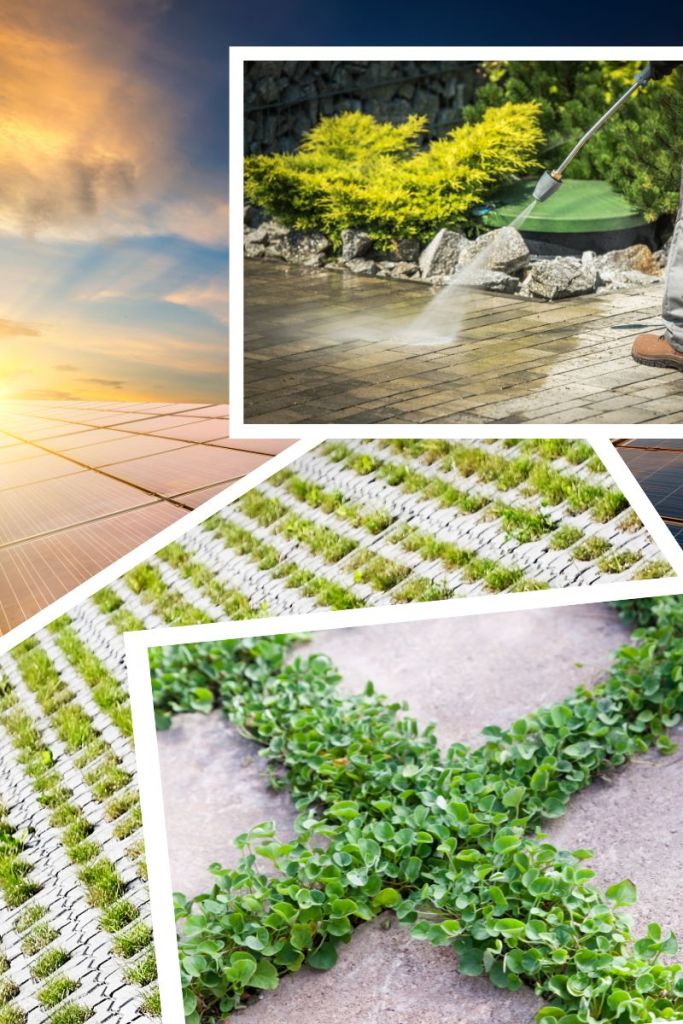
“Solar Freakin Roadways!!!” 👽- Yes, you read this right! There is a company in Idaho called Solar Roadways that makes solar road panels [<= CLICK THAT LINK. THE 7-MINUTE VIDEO IS ENTERTAINING, ENLIGHTENING AND A MUST-SEE!]. Pros: This is an amazing technology that uses sustainable materials to make, not just solar, but SMART road panels. They are modular panels that fit together to prevent cracking. They generate energy, produce an ROI, charge electric vehicles, enable underground wiring, provide traction, heat up to prevent ice and snow accumulation, light up for a festive display, can send emergency alerts, and can be programmed on demand to create range of light patterns or sports quarts, and yes, they provide a place to park! Cons: As an emerging technology, they are not cheap at the moment, but the price will come down.
Hemp 🪴- Pros: Light-weight bricks can be created from the strong inner fibers of hemp that can last for years. The lighter weight makes transporting them less expensive and less impactful on the environment. The added bonus is that they absorb carbon from the atmosphere just like trees. Cons: Hemp might not be legal in all areas.
Fungi 🍄🟫 – Pros: This is another evolving technology where mushrooms can actually be used to make strong bricks! Fungal threads, or mycelium, are introduced to a substrate which they consume, digest, and convert into a strong solid mass. The mycelium basically act like “glue that binds together different natural particles” says Critical Concrete. The benefits to mycelium are that it can create material that’s stronger than concrete, can absorb more heat than fiberglass, is fire-proof, non-toxic, very light weight when dry, and can last up to 20 years if maintained in favorable conditions. Cons: the mycelium is water and mold resistant initially but gradually loses this capacity over time. The key is finding ways to keep it in stable conditions to prevent it from decomposing.
I hope this article sparked some awareness and intrigue 🤩 about green alternatives that support sustainability. The more we learn about the ways to protect our environment, the more focused on its importance we may become, and the more we can take action for a greener 💚 and more sustainable 🔮 future.
Please share your comments below.





 Fairfield and Westport CT Real Estate Guide